Introduction
CitriniResearch’s raison d’etre is taking complex topics of interest for investors and explaining them in a way that’s intuitive. That’s why our work spans so many asset classes, and it’s why sometimes we write in-depth sector primers, macroeconomic missives and, occasionally, hypothetical scenarios that result in us receiving death threats (only semi-credible ones).
Talking about something confusing is what gets us excited. It’s also where great investment ideas are born.
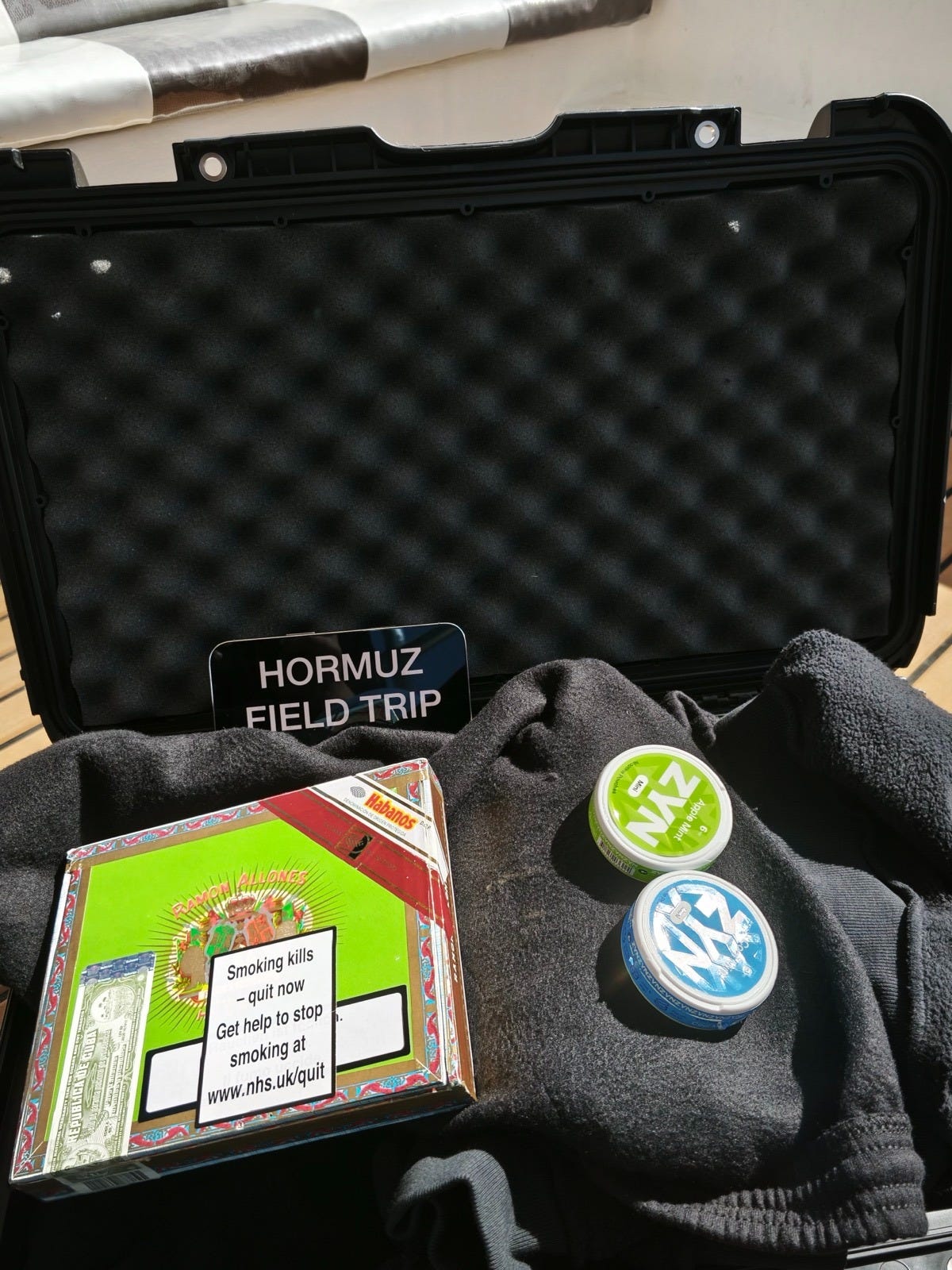
The situation in the Strait of Hormuz is nothing if not confusing right now. So, CitriniResearch sent our incredibly capable field analyst – dubbed Analyst #3 in order to avoid emotional attachment – on assignment to the Strait of Hormuz. Armed with a fluency in four languages including Arabic, a Pelican case full of equipment, a pack of Cuban cigars, $15,000 in cash and a roll of Zyn, #3 set out to fulfill the itinerary we’d planned in our Manhattan offices the week prior.
We figured we’d leave with an impression that was basically “The strait was closed or open.” We also were quite aware that the trip might be a flop and we would learn nothing at all. However, we came away with a much more nuanced understanding of the current environment and the transition to a multipolar world.
If David Foster Wallace were alive today, he’d be reporting from the bar in a beachside town on the Omani coast– taking notes on a napkin about the particular quality of silence in a hundred-room hotel with three guests, watching tankers drift towards, but never quite reach, the Strait of Hormuz. That’s our inspiration here, if DFW was also concerned with finding alpha.
This is a story about the most consequential place on Earth right now — the fifty-four-mile passage between Iran and Oman through which the global economy flows, or doesn’t. There was no shortage of alpha on the Strait, including concrete information on the new rules, being written as we speak, on how the Iranian Revolutionary Guard is deciding who can, and can’t, pass.
Analyst #3 decided – against the counsel of an Omani border agent, the implicit counsel of God, and the extremely explicit counsel of two Coast Guard officers holding assault rifles – that he was going to the center of the most consequential waterway on earth, during a live war, in a speedboat with no GPS, captained by a man he met three hours ago at a port inlet by pulling out a wad of cash. For investment research purposes.
Here’s the story.
Into the Strait
Before crossing into Oman, the officer asked Citrini Analyst #3 to sign a document. The pledge — preprinted, presented over tea at a desert checkpoint — was an agreement not to engage in photography, journalism, or info gathering of any kind within the Sultanate of Oman. He signed it.
The officer then opened Analyst #3’s rugged Pelican case to inspect it. What he missed: the gimbal, the microphone kit, the recording sunglasses. The assignment was on.
On the other side, #3 talked his way onto a rickety speedboat with no GPS, defied advice from Omani officials to turn back, and rode on the open seas eighteen miles from the Iranian coast while Shahed drones flew overhead and Revolutionary Guard patrol boats ran patterns in the distance. He swam in the Strait of Hormuz smoking one of the Cubans he still had on him.
And then, he was intercepted by the Coast Guard, detained, and had his phone confiscated — before, eventually, making it back home to share everything he’d learned with us in an 8-hour debrief session.
This is what Analyst #3 found on his field trip to the Strait of Hormuz, from his point of view, with some key names, places and details of key events changed to protect the safety of anonymous sources. The quotes are based on his memory of the events, translated from the original Arabic. Which is the best we could do from an accuracy standpoint — considering #3’s phone, and all of the notes and photos on it, is thousands of miles away, likely being combed through by the Omani authorities as we speak.
I. The Idea
“What if I just went to the Strait of Hormuz?”
It’s the kind of question that starts as a joke — the kind of thing you say at two in the morning to yourself in bed that doesn’t survive contact with daylight, that joins the vast graveyard of schemes you were absolutely going to execute before you fell asleep and woke up a person with responsibilities again. But it wasn’t 2AM, and we weren’t in bed.
We were sitting in CitriniResearch’s offices, in Midtown Manhattan, watching the biggest geopolitical crisis of the decade unfold on our phones. We watched the most liquid markets in the world fluctuate like meme-coins in a game of Trump Tweet-AP Headline pong.
It was clear that nobody — literally nobody, not the analysts, not the correspondents, not the retired generals doing hits on cable news and least of all us — actually had any idea what was going on. Everyone was working from the same stale satellite imagery and the same unnamed Pentagon sources and the same AIS shipping data, which, as I would later discover, was missing roughly half of what was actually transiting the strait on any given day.
And, after all, wasn’t it our job to make confusing investment environments less confusing? I wanted to do that, I had the connections to make it happen (at least some of it) and it would make for a pretty great story. So it was decided.
From Citrini’s apartment in New York, we packed a Pelican case with a Xiaomi phone (that had a Leica camera with a 150x zoom, a souvenir from our trip to visit Robotics factories in China), an EPIRB, $15,000 in cash, a gimbal and a microphone kit. We sat down and researched an itinerary, working backwards from the questions we most wanted answered.
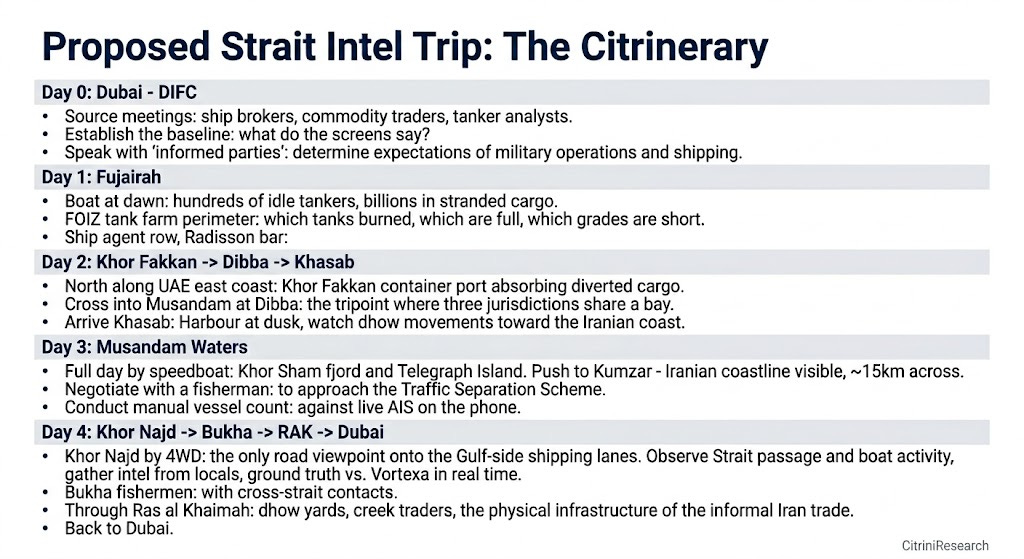
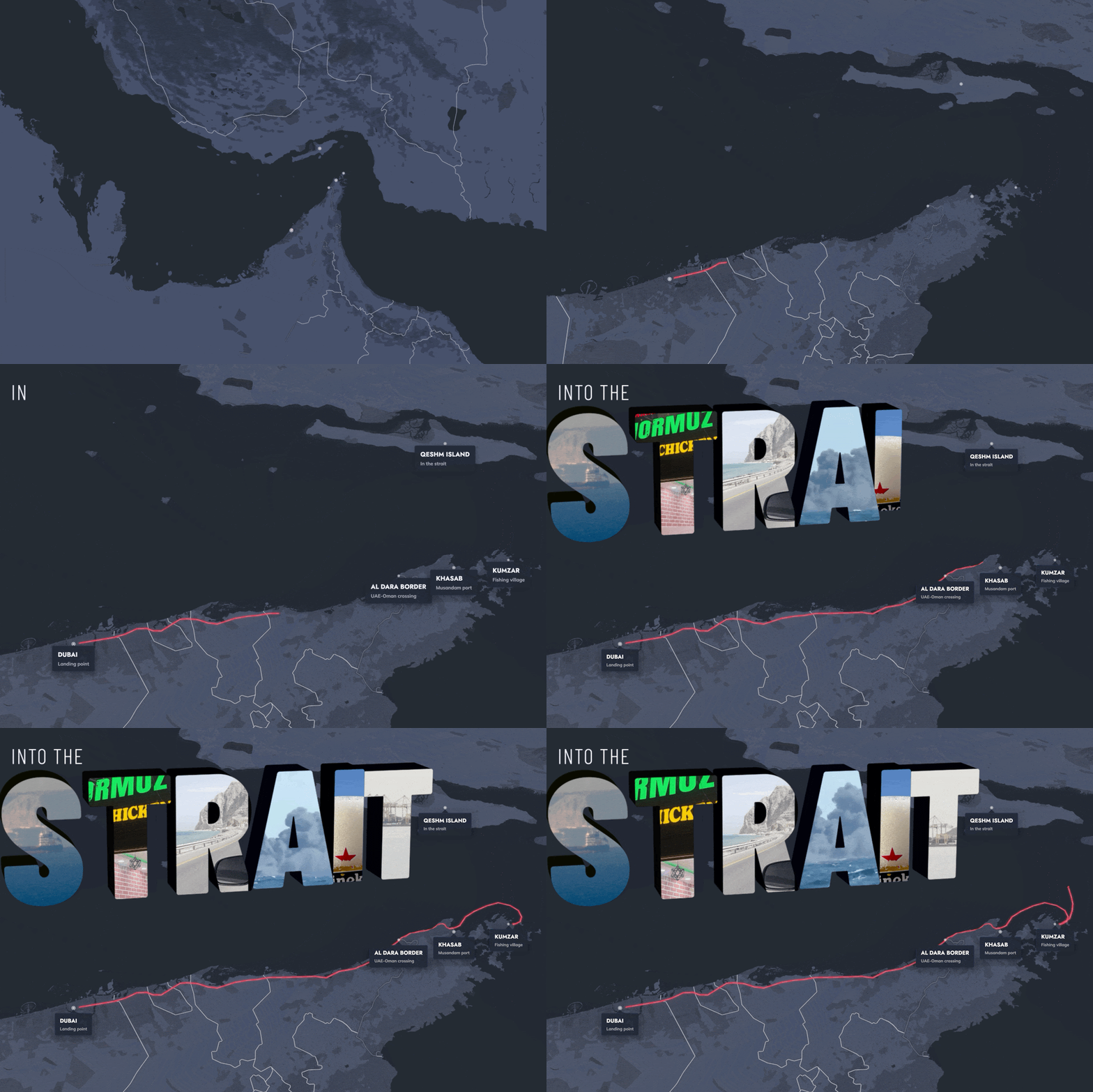
I’d land in Dubai, speak with some informed parties I knew and contacts of CitriniResearch’s, drive to Fujairah for some B-roll and information gathering at the oil terminal, then cross into northern Oman’s Musandam province, get to Khasab, and try to get on the water.